

Tracking Opioid Settlement Funds Around the Country
Opioid settlement funds will channel more than $56 billion dollars to state and local governments to prevent addiction, provide treatment to people struggling with substance use disorders, and support people in recovery.
Companies that played a role in creating the opioid crisis have settled thousands of lawsuits, and the resulting influx of funds is meant to help state, local, and tribal governments abate the harms these companies helped to create. As governments were preparing to receive these funds, advocates became concerned that the money would be misspent, like happened with Tobacco Master Settlement Funds, where less than 4% of settlement funds were spent on tobacco prevention and cessation in FY 2025.
In 2021, the first year that opioid settlement funds began flowing to state and local governments, nearly 110,000 people died of a drug overdose death. Fentanyl, paired with the Covid-19 pandemic, caused overdose deaths rates to soar, and extra funding to save lives was needed more than ever.
Nonprofit organizations like Shatterproof participated in the creation of the Principles for the Use of Funds from the Opioid Litigation, led by Johns Hopkins University Bloomberg School of Public Health (JHU), to ensure that funds would be spent to save lives.
Shatterproof partnered with JHU to promote the adoption and implementation of The Principles around the country, and to date the Principles have been endorsed by over 60 nationwide organizations and adopted by countless state and local governments as guidance for spending opioid settlement funds.
The Principles call for transparent reporting of expenditures, but the unanswered question was who is going to track how funds are spent across the country. Every state has a different approach regarding who controls the funds, priorities for spending, and reporting requirements. Shatterproof and JHU partnered with KFF Health News to tackle this challenge in 2023. We gathered input from states, developed a methodology, and assembled a small team to collect and categorize the data. We published our findings at the end of 2024 and immediately started planning for the next round.
The first round of data collection covered calendar years 2022 and 2023 and showed that many jurisdictions were not immediately spending funds – almost one-third of funds received were not spent during the time period. Some jurisdictions were rushing to set up infrastructure and processes to distribute the money, and others were waiting for the results of a needs assessment or strategic planning process before they began spending the funds in earnest.
Loading...
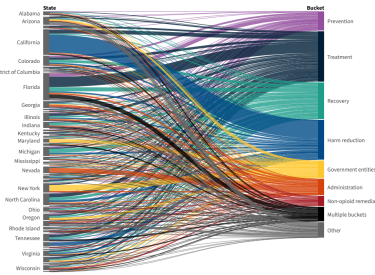
In the second year of the project*, we captured more than 10,000 expenditures around the country. Similar to the first year, the majority of funds went to substance use disorder treatment and the smallest nationwide outlay was for treatment for neonatal abstinence syndrome. To explore the full database of expenditures, you can download it here.
For those who want a say in how funds are spent where they live, many jurisdictions have advisory councils that may have seats available or allow for public comment. In jurisdictions without advisory councils, elected officials usually decide how funds are spent, so you should reach out to your state and local representatives to weigh in.
*When we started the process to capture 2024 spending, we made minor changes to the methodology and due to this and reporting differences (some jurisdictions report by fiscal year, so their FY 24 expenditures were captured in our first and second reports), it’s not possible to compare the first and second rounds of our reports.
You might also like...