

Where is the Opioid Settlement Money Going? What 17,500 Spending Decisions Tell Us
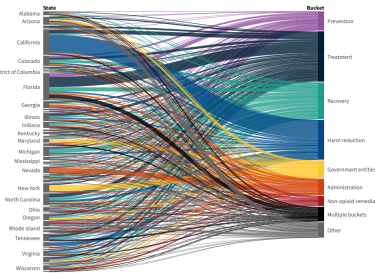
For 4 years, Shatterproof has worked with KFF Health News and the Johns Hopkins University Bloomberg School of Public Health to follow the money and show the public where it's going. It is the only effort of its kind tracking opioid settlement spending across the country. This year's database covers more than 17,500 spending decisions made by state and local governments in 2025. Below, you can use the interactive charts to explore the data yourself.
The big picture
$3.7B
Governments spent or committed about $3.7 billion in settlement money in 2025.
$786M+
About 20% went to helping people stay in recovery, for things like housing, transportation, and job training.
$340M+
Went toward helping people find or keep a stable place to live, including through rental assistance and recovery housing.
<1%
Two proven approaches, syringe service programs and support for babies exposed to drugs before birth, each got less than 1% of the national total.
12 states
At least 30% of settlement money can't be tracked through public reports.
$3.7 billion in one year
In 2025, state and local governments spent or committed about $3.7 billion from opioid settlements. Some reported spending more than they received that year because they dipped into funds they received in earlier years. Most of the companies that settled are paying out to state and local governments over time, so these decisions will keep coming for years.
Try it yourself: You can search the database below or download the data to explore how opioid settlement funds were spent in your state.
Helping people stay in recovery
About 20% of the 2025 spending went toward long-term recovery. That is more than $786 million for housing, transportation, job training, and other support that helps people build stable lives after treatment. Recovery doesn't end when treatment does, and these dollars help people keep going.
Try it yourself: Click on a state or a spending category in the chart below to see where that money went.
Housing is a priority
Governments reported spending more than $340 million on housing, including rental vouchers and recovery housing. Although not one of the main spending categories, housing is an allowable use of opioid settlement funds that is usually meant to support people in recovery. It received about as much as prevention efforts and more than overdose reversal medications like naloxone.
Some proven approaches are being left behind
Most of the settlement agreements outline nine core strategies to address the opioid crisis, but the money is not being spent evenly across them. Our data shows that most of the funds are being spent on:
Initiatives that don’t align with any of the nine core strategies33%
Programs that support recovery and warm-handoff services21%
Treatment for substance use disorder, including medications for opioid use disorder14%
Prevention programs that aim to stop addiction before it starts9%
Meanwhile, syringe service programs and support for babies exposed to drugs before birth each got less than 1% of national spending. These approaches are backed by research. When they go underfunded, communities lose tools that keep people alive and connected to care.
Try it yourself: Use the drop-down menu in the chart below to select your state and see which strategies it prioritized.
Too much of the money is unaccounted for
In most states, settlement funds are split between the state and local governments. While transparency in spending decisions is improving, too many state and local governments still don’t report on how they’re spending the funds. In 12 states, at least 30% of settlement dollars can't be accounted for in public reports.
Try it yourself: Find your state in the chart below to see which settlement expenditures are publicly available, which were obtained by public record requests, and which are unaccounted for.
Opioid settlement funds are meant to mitigate the harms caused by the opioid crisis through increased investment in evidence-based initiatives to address substance use disorder, but we know the funds aren't always spent that way. The ability to see where the funds are being spent is important because people can only hold leaders accountable for decisions they can see.
"These dollars exist because of tremendous loss, and the people who have been touched by this crisis deserve to know where the money is going and how those decisions are being made. Every dollar counts, just as every life lost to opioids matters. This data gives families, advocates, and community members the information they need to ask questions, hold their leaders accountable, and push for spending on approaches that save lives."
Kristen Pendergrass, Vice President, Policy, Shatterproof
Shatterproof is working to make sure settlement money goes to approaches proven to save lives and adds to existing efforts rather than replacing other funding. This data is helping guide community advocacy, inform lawmakers, and support important research. Shatterproof is also a champion for the Principles for the Use of Funds from Opioid Litigation, led by the Johns Hopkins Bloomberg School of Public Health and endorsed by more than 60 national organizations.
What needs to happen next
1. Show the spending.
Every government that controls settlement money should publicly report how it's used. We're working with states to increase transparency to inform the public.
2. Fund what works.
Spend the funds on approaches backed by research and evidence across prevention, treatment, harm reduction, and recovery, including the ones being underfunded today.
3. Add, don't replace.
Settlement money should add to current addiction services, not stand in for funding that already exists.
4. Get involved.
Residents, advocates, and community leaders can use this data to ask questions and guide future funding decisions.
Keep exploring
The charts in this post are interactive, so take your time with them. Find your state, click through the categories, and see where your community's settlement money is going. Then share what you find with someone who cares about this issue.
Dig even deeper by searching and downloading the full database.
Want to learn more about opioid settlement funds? Read our Opioid Settlement Funds FAQs.